
Explainer 10 min
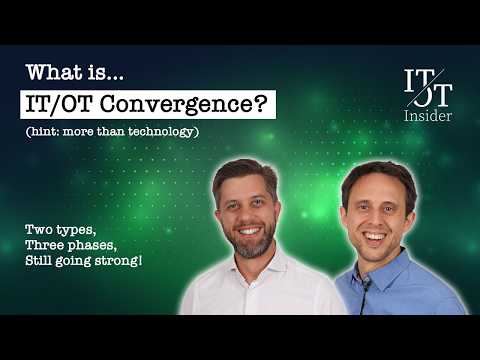
What is… IT/OT Convergence (hint: more than technology)
Infrastructure convergence made it possible for IT and OT to share a network — and then made it necessary for them to share responsibility for what runs on it. Cybersecurity convergence made it possible to attack both sides of the business at once — and then made it necessary to stop treating IT and OT security as separate disciplines. Data and AI convergence is making it possible to build one data foundation across both worlds — and it will make it necessary to figure out, organisationally, who's accountable for it. That's really the answer to "what is IT/OT convergence": it's not a single project you finish, and it's not primarily a technology purchase. It's an ongoing pattern of two technical worlds discovering, wave after wave, that they need each other more than either side originally expected.
In This Episode
- IT/OT convergence isn't one thing, David insists it has to be split into a technical side (shared technology and protocols) and an organizational side (IT and OT people actually working together), and the two need to be discussed separately.
- Technical convergence means OT increasingly reusing IT's toolbox, IoT, Windows servers, standard networking, TCP replacing serial/fieldbus communication, but David is direct that "technical convergence is only as good as the people who are working with it."
- Organizational convergence does not mean forcing IT and OT into one hierarchy or one team; David frames it as one of the ITOT Handbook's seven cooperation patterns, not a single prescribed structure.
- David lays out three historical phases of IT/OT convergence: infrastructure first (largely solved today thanks to 4G/5G/LoRa and mature vendors), then cybersecurity, and now data plus AI, the current focus.
- Cybersecurity convergence was triggered by Stuxnet: before it, OT was widely assumed to be too obscure to attack; afterward, OT cybersecurity became its own discipline, though David argues integrated IT/OT cybersecurity is now a genuine license to operate since hackers don't respect org charts.
- In the current data-plus-AI phase, Willem argues the data side has already been substantially explored (roughly a decade of active OT data use) while the AI side is still being figured out, with AI now acting as an accelerator for building better data foundations.
Cold Open, and Getting to the Real Question
00:00 – 01:19The video opens with a quick teaser cut of the conversation to come, before David and Willem actually sit down to answer the question properly: what is IT/OT convergence? David frames it as a genuinely misunderstood term, coined around the same time Industry 4.0 was introduced, important enough to deserve its own "what is" video and a chapter in their ITOT Handbook.
He immediately sets up the structure the rest of the video follows: there's no single thing called IT/OT convergence, it has to be split into a technical side and an organizational side, and the two get discussed one at a time, starting with the technical one since, as engineers, that's the easier place to start.
“That's really good question. So the term is coined around the same time Industry 4.0 was introduced. It's also one of the more misunderstood ones.”
David Ariens · 00:37
Technical Convergence: Borrowing IT's Toolbox for OT
01:19 – 02:26David walks through what technical IT/OT convergence actually looks like in practice: reusing technology IT already relied on, inside OT. That's where IoT got its start, where Windows servers and standard networking components entered plant environments, and where serial communication and fieldbuses began giving way to plain TCP communication, all in service of exchanging data more easily.
He's clear this is a good thing, technology stacks need to evolve, but closes with the pivot the rest of the video builds on: technical convergence is only ever as good as the people actually working with it, which is what pulls the conversation straight into organizational convergence.
“We're engineers. Technically is always easier. Technical IT/OT conversion is really, if we go back 15, 20 years in time, there was still a distinguish between the technology OT was using and IT was using.”
David Ariens · 01:19
Organizational Convergence: Two Technical Tribes Learning to Work Together
02:26 – 03:36Willem reframes convergence in people terms: as the technology gets closer together, IT and OT suddenly have to start working together, which is a different challenge than IT's usual cross-department interactions, because here both sides are equally technical, equally comfortable with servers and networks, and equally confident they can figure things out themselves.
David adds the crucial nuance: organizational convergence doesn't mean forcing IT and OT into one hierarchy or one team. It's genuinely one of the seven cooperation patterns from their ITOT Handbook, worth its own video, rather than a single prescribed structure.
“Both groups, they want to do the best for their company. They don't want to start a war between the two silos, but they come with their own background, their own expertise, and they are comfortable figuring it out themselves.”
David Ariens · 03:00
Three Phases of Convergence, Starting With Infrastructure
03:36 – 04:51Willem asks how we actually got here, prompting David to lay out IT/OT convergence's three historical phases: infrastructure first, then cybersecurity, and now data plus AI. On infrastructure, he argues the problem is essentially solved: where early machine-to-machine communication meant maintaining complex, bespoke local networks, today's 4G, 5G, LoRa, and internet service providers mean the technology exists off the shelf, from any number of capable vendors.
“The term, as we said, exists now for 15 odd years. But it went through several phases. First, you had the pure infrastructure convergence. Then we stepped into cybersecurity. And now we're talking about data and AI.”
David Ariens · 03:47
IT Teams in the Physical World: Sensors, Glue, and Batteries
04:51 – 06:04Willem gives a concrete picture of what that infrastructure shift actually looks like on the ground: sites where there's no dedicated OT team at all, just an IT team directly managing remote sensors, an IT stack now handling everything from sensor to data analysis. That pulls IT into distinctly physical, un-IT-like questions, what's the best glue to use, who changes the battery, that simply don't come up in a normal IT department.
David ties it back to the organizational thread: introducing a technology is easy, doing it inside real physical operations is a different, harder problem, which is exactly why convergence can't be treated as purely technical.
“That also meant that suddenly IT was entering the world of operations, of the physical world. You suddenly get very different discussions than you have normally in IT, like what's the best type of glue? Who's gonna change the battery?”
David Ariens · 05:38
Phase Two: Cybersecurity, From "We're Too Obscure to Matter" to Stuxnet
06:04 – 07:30David calls connectivity and cyber risk a one-on-one relationship: once systems started connecting, they became a playground for hackers. Before roughly 2010, almost nobody in an industrial setting worried about cybersecurity, the assumption was that OT was simply too obscure to be worth attacking, and, as Willem notes, hackers were busy chasing credit card numbers and corporate secrets instead.
Stuxnet changed that permanently, kicking off OT cybersecurity as its own discipline, initially with completely separate organizations, policies, and tooling from IT cybersecurity. The problem, David says, is that hackers don't respect org charts, they'll exploit whatever gap is there, which is why integrated cybersecurity across both IT and OT has become what he calls a genuine license to operate.
“That changed with, we all know, Stuxnet. That really started the OT cybersecurity thing. And in the beginning, in these early years, we saw that OT cybersecurity and IT cybersecurity were still separate organizations, even separate policies, separate tool sets.”
David Ariens · 06:54
Phase Three: Data Plus AI, or Is It AI Plus Data?
07:30 – 08:51David introduces the current, third phase: data and AI, joking that he's still not sure which comes first. Willem's answer is blunt, without data, doing useful AI is going to be hard. David agrees and adds context: OT data has already been actively used for roughly a decade, and AI is now acting as an accelerator, driving renewed focus on building the data foundation needed to scale AI use cases, hence the current wave of interest in data structuring, graphs, and ontology.
“I think if you don't have data, it's gonna be really hard to do AI, David. You can do stuff, I just don't know if it's gonna be useful.”
David Ariens · 08:02
Unifying Data Planes, and the Recap
08:51 – 10:25Willem notes the asymmetry in where things stand: the data side has already been explored, it's not starting from scratch, while the AI side is still very much being figured out. Technically, that means unifying data planes, bringing data in centralized, structured, scalable form. Organizationally, it means the same convergence challenge as ever: bringing teams together to actually work that way.
David closes with a clean recap: technical and organizational convergence, and the three phases from infrastructure to cybersecurity to data and AI, before pointing viewers to ITOT Insider's free content, the ITOT Academy's instructor-led program, and the ITOT Handbook.
“So there you have it, now you know what IT/OT convergence means. Technically, organizationally, and the three phases from infrastructure to cyber to data and AI.”
David Ariens · 09:33
Full episode transcript raw feed ▸
Willem: What's ITOT convergence? David: Technical convergence and organizational convergence. There is no one thing. Willem: What happened once we started connecting systems? David: Playground for hackers I now today data plus AI or is it first AI and then data? Sometimes I Willem: I think if you don't have data it's gonna be really hard to do AI David. David: Ha ha. Willem: Hey David. David: Yes, Phyllum? Willem: What's ITOT convergence? David: That's really good question. so the term is coined around the same time industry 400 was introduced. it's also one of the more misunderstood ones. so I think that calls for an what is video, huh? What is ITOT convergence? Why are we even talking about it? And also why are we writing about it in our ITOT handbook? Willem: Yeah, David, let's start with the what what is it? David: Absolutely. First of all, super important to distinguish between technical convergence and organizational convergence. There is no just there is no you know one thing. where should we start? Technically or organizationally? Willem: Let's start with the technical one. They're engineers. David: We're engineers. Technically is always easier. Technical ITOT conversion is really if we go back 15 years in time, 20 years in time, there was still a distinguish we distinguish between the technology OT was using and IT was using. we reuse technologies of the shell of technologies we have in the IT world, also in the OT world. This is also where IoT was introduced. This is where we started using Windows servers and standard networking components. We started switching away maybe from the old serial communication, field buses to TCP communication, etc. And today we're obviously talking about how are we going to exchange data in the most possible or the most easy way. This is really the purely technical side of ITOT convergence. And You know, that's a good thing anyways. I think the world is evolving, our technology stack also needs to evolve. But technical convergence is only as good as the people who are working with it, and that brings us automatically to organizational convergence. Willem: Yeah, I think with the technologies coming closer together, more possibilities to get systems connected also suddenly means that we need to start working together. And that's what OT convergence, IT OT convergence can also mean. It's like getting people from those two technical organizations working together. Because unlike normal interactions that that IT has, for example, with other departments, we're really talking about two very technical departments. Comfortable working with servers, networks and everything on top. and that brings challenges. David: Yeah, that's really important. It's important to understand that those are two technical groups. Both groups, they want to do the best for their company. They don't want to start a war between, you know, the two silos, but they come from their with their own background, their own expertise, and they are comfortable figuring it out themselves. ITOT convergence, at least the organizational side of ITOT convergence, doesn't per se mean having one. Hierarchy, one organization, one team with both IT and OT people. Actually, and this is also a plug to our book, it's actually one of our seven cooperation patterns, but that's something for another video. Willem: We have technical ITOT conversions, we have organizational ITOT conversions. but I think it's maybe worth it to go a little bit deeper, like how did we get here? Yep. David: Absolutely. The term, as we said, exists now for 15 odd years. But it went through several phases. Very simple. First, you had the pure infrastructure side of things. So the pure infrastructure convergence. Then we stepped into cybersecurity. And now we're talking about data and AI. Let's start with infrastructure. If we go back in time, you know, we were Happy to have machine-to-machine communication. you know, introduction of IoT in the beginning, you had these very complex local networks which you had to maintain yourself. But today we have 4G, 5G, we have LoRa, we have service providers on the internet. so the pure infrastructure sites, I think we could easily say that you know, from a technological point of view, there is really not a problem anymore. There are so many vendors offering so many integration possibilities. I think there, you know, it's just go to the internet, pick good vendor, go with it. Willem: Yeah. I I think you will for me this is like a really very good clear example of of IT OT convergence from a technical perspective because now you had an IT stack that could do everything from sensor to data analysis on all those readings and managing it. And you have places out there where they don't have an OT team, they just have an an IT an IT team managing remote sensors. Absolutely. That also meant that suddenly IT was entering the world of of operations, of the of the physical world. I mean, you suddenly get very different discussions than you have normally in IT, like what's the best type of glue? who's gonna change the battery? These are not problems we're used to have in IT. David: No, no, no, no. And there again we're back to the organizational side. Like, okay, it's easy to introduce a technology. It's much, much, much more complex to do that in the context of our physical operations, which is still something special, maybe. Willem: It makes it unique. now if we leave that world aside, what happened once we started connecting systems? David: Yeah, that's the best playground for hackers. I I I'm not only guessing, I know I've been I've been working on cybersecurity for so many years. with connectivity came cyber risks. Like it's a one on one it's a one on one relationship. let's say back before twenty ten, nobody in an industrial setting really cared about cybersecurity. We thought you know we had something special obscure. Willem: It is obscure and I I don't think that hackers really cared that much back in the time because I mean they were probably more interested in credit card numbers or corporate secrets or getting access to the mail of the CEO, stuff like that. David: Absolutely. That changed with the we all know Stuxnet. Obviously, Stuxnet is some something really, really special. But in any case, for me, that really started the OT cybersecurity thing. And in the beginning, in these early years, we saw that OT cybersecurity and IT cybersecurity were still separate organizations, even separate policies, separate tool sets. The problem, however, in today's world is Hackers don't really care too much about Orchards. Willem: Think they'll exploit it even if they can. David: Yeah, absolutely. So that means that today, integrated cybersecurity, both on the IT as well as the OT side, from a technical perspective and an organizational perspective, is not only important, it's it's licensed to operate. so that's I would say the second phase. Still extremely important, but today, you know, it's it's starting to become commonplace. and that brings us to the third phase of ITOT convergence, and that's now today data. Plus AI or is it first AI and then data? Sometimes I Willem: I think if you don't have data it's gonna be really hard to do AI, David. you you can do you can do stuff. I just don't know if it's gonna be useful. David: Absolutely. So with I and I I I think it's fair to say that data has been around for a decade or so, or at least a using OT data has been around now active for a decade or so. with AI comes an accelerator, and now with AI we see that there is again a new focus on building that data foundation to enable those use cases to be scaled. We're now starting to see, you know, things about data structuring and graphs and ontology and all the foot and all the fun stuff. So this is really the current phase of IT OT conversion. This is where we are currently focusing on. That doesn't mean the infrastructure part and the cybersecurity part are less relevant. They are still as relevant as ever. Willem: I think especially on the on the AI side, we're still exploring and searching what it means. But the data side itself, like you said, has been already explored. So we're not starting from scratch there. And I think that means both on a technical perspective, it means unifying your data planes. How do I bring that data in a structured way, centralized, scalable within IT, so I can start to scale applications from a technical perspective? But once again We're bringing those technologies together, we're bringing teams together. It's also about how do we work together. Mm-hmm. within IT and OTE, again, the organizational part is not that far away. David: So there you have it, now you know what ITOT convergence means. Technically, organizationally, and the three phases from infrastructure to cyber to data and AI. if you wanna go past the buzzwords, if you actually wanna dig into digitizing manufacturing, head over to itotinsider.com for our free contents, go to itoti.academy for our instructor led program where you can interact with the both of us and ask us the difficult questions. But not just us, also your peers. That's equally interesting, maybe even more interesting. than asking us. and finally, grab your copy of the ITOT handbook. You can find it at ITOT book.com. See you next time for more WhatsApp. Bye bye. Willem: Do you?